
Why Your Nerves Won't Heal — and What May Help
▶ 8-min video
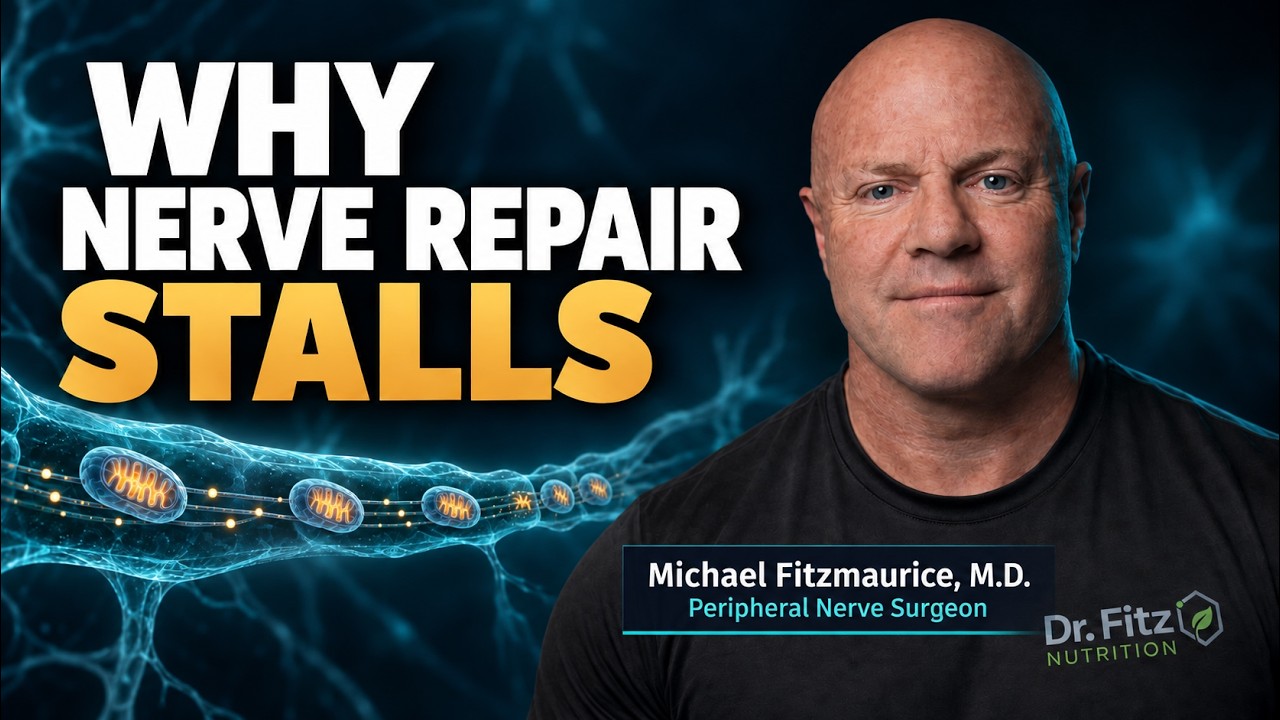 Tap to play · 8 min
What you'll learn in this video
- Why nerve repair takes so much energy, and what ATP has to do with it
- What mitochondria do for nerve cells beyond making energy
- Axonal transport: how mitochondria travel down a long nerve to reach a repair site
- The "mitochondrial traffic jam" researchers describe in diabetic and chemotherapy-related neuropathy
- Why insulin resistance can affect nerve cells long before blood sugar is very high
- Exercise, sleep, and nutrition habits that support healthy mitochondria
- Nutrients studied for mitochondrial support (alpha-lipoic acid, acetyl-L-carnitine, CoQ10, NAC, benfotiamine, curcumin), and why Dr. Fitz combined them in NeuroAxis
- Experimental research, including support cells that may pass mitochondria to injured nerves
Why do some nerves recover while others stall? In this video, Dr. Fitz explains why nerve repair is an energy problem as much as a tissue problem: the mitochondria that power nerve cells have to travel the length of the nerve to reach a repair site, and research suggests that transport can break down in diabetic and chemotherapy-related neuropathy. He covers how insulin resistance affects mitochondria, the exercise, sleep, and nutrition habits that support them, the nutrients researchers have studied, and experimental work on new approaches. No supplement has been shown to regenerate nerves on its own.
Watch next
 7 Things Your Nerves Need to Heal: What the Research Shows
 How to Tell If Your Neuropathy Is Improving (4, 8 & 12 Weeks)
 Why Your Nerve Pain Won't Go Away: The Hidden Inflammation
Educational content, not medical advice. Talk with your own doctor before changing medications, treatments, or your exercise routine.